How Does a Child Learn to Read?

girl, reading book, outdoors-5819259.jpg

How does a child learn to read?

Have you ever seen a child who was learning to read who would accurately sound out each letter, but when it came time to say the whole word, would say a completely different word?

S-A-T = SACK

What happened?

One of the main things I’ve been doing is learning what the experts say about children’s literacy. I am going to scour the ends of the earth, go to educator’s websites, like Education Week and Cox Campus; YouTube channels, like @RUTeaching and Toddlers Can Read; and organizations like Black Literacy Matters and The Latino Family Literacy Project.

I will chronicle my journey through this blog.

I hope you join me as I go forth.

So, with this in mind, I stumbled upon @RUTeaching on YouTube. They have a video “How Children Learn to Read, with Margaret Goldberg”, and let me tell you, the information Ms. Margaret imparts is outstanding! It really clarifies what it takes to teach a child how to read, using the Science of Reading. She covers how research leads to instruction, how the brain reads, how we use letters and sounds for reading, and how we use meaning and context for reading.

Two areas that really piqued my interest are how reading comprehension is assessed and what the concept of phonological processing is: both are directly related to the success of teaching a child to read.

The whole video is a great watch, and I’ll do another post on the second half, because she’s divulges even more awesome information with every second of her video.

Reading Comprehension

The way Ms. Margaret puts this is by using the equation: D x LC = RC.

Decoding multiplied by Language Comprehension equals Reading Comprehension.
Decoding is being able to see words on the page and pronounce them.
Language Comprehension is the ability to understand what the words mean.
If you are able to do both at the same level, you have reading comprehension.

1 D x 1 LC = 1 RC
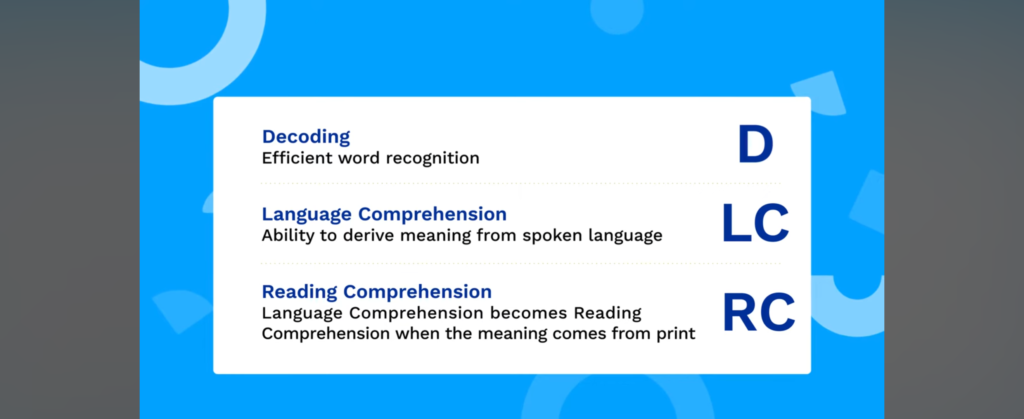
D x LC = RC equation from YouTube video
Equation from YouTube video “How Children Learn to Read, with Margaret Goldberg”

But, if you are only halfway good at one, like decoding, yet you understand what the word means, like they do with sight words (words recognized by sight which traditionally was taught using rote memorization), then you would only have half the reading comprehension for that child.

1/2 D x 1 LC = 1/2 RC

She goes on with more equations, most notable of which we know, if you have zero of anything in that multiplication equation, the total would equal zero as well.
This was so awesome for me to see and I was so thankful I found Ms. Margaret’s YouTube video. She talks about this so clearly and succinctly, you can see she’s an educator.

Phonological Processor

The other area that really fascinated me is when she talked about the phonological processor. The phonological processor is the part of the brain that processes the sounds in the spoken language.

There are 44 or so sounds in the American English language.

Consider this: in order to read, one must distinguish sounds disparately, words have to broken down into separate letters with distinct sounds that vary sometimes within the same word.

I mean, we all know “a” could be “ah”, or “eh” or, “ay”, etc.

Amazing to think our little toddlers can and have been handling this type of stuff since the beginning of time. It’s kinda cool, honestly.

Anyways, to reiterate, the phonological processor is the ability to decipher between different sounds. If you have a strong phonological processor, when you hear a sound, you will be able to:

So, if one has a weak phonological processor, imagine how much harder it’d be for that child to advance in their reading skills.

To a child with a weak phonological processor, sounds, much less whole words, are harder to distinguish and decipher:

invisible : invincible
pin : pen

Blending sounds becomes much more difficult. Hark back to the opening quandary:

S-A-T = SACK

After watching her video, I get it now. In the past, I have come across situations like this, where someone would sound out a word, but when it came time to say the whole word, they’d say a totally different word than what it’s supposed to be. Whether it’s my own children when they were young, or their classmates.

I’m sure y’all have come across this as well.

The science behind something so prevalent and problematic is very interesting to me. Here’s that great video in its entirety. Great watch.

Sight Words

With phonemic awareness being such a huge first step for children’s literacy, it makes me wonder—and a post by Toddlers Can Read that has amassed millions of views can attest to this—if the mandate of memorizing sight words is taking too much time away from strengthening the phonological processor?

When my kids were in elementary school, they’d come home with a bunch of sight words every day that they would spend quite a bit of time memorizing. Decades later, after looking it up, it seems memorizing sight words in Texas is still a thing. According to the TEKS Guide for Texas English Language Arts, six- to seven-year-old students are expected to recognize a minimum of 100 sight words per year.

Wait a second. Let’s back up.

First-graders are expected to have learned how to decode and blend already. Let’s back up even more.

To kindergarten, we go.

When I look up what Texas does for English Language Arts and Reading in Kindergarten, it starts with oral proficiency of learning how to follow instructions and getting used to a structured environment. Beginning with block K.2 the children start learning about phonics.

  • K.2.A.i starts morphing—rhyming
  • K.2.A.ii recognizing spoken alliteration, words with the same initial sound
  • K.2.A.iii developing phonological awareness (movement/actions like clapping to show awareness of separate words in a sentence)
  • K.2.A.iv breaking words into syllables
  • K.2.A.v blending sounds into words  hip-po=hippo
  • K.2.A.vi backwards, breaking words into sounds  hippo=hip-po
  • K.2.A.vii develop word structure knowledge using all the previous concepts  r-ag=rag, th-is=this
  • K.2.A.viii blending spoken phonemes to form one-syllable words  s-i-ng=sing
  • K.2.A.ix develop word structure knowledge using all the previous concepts primarily via morphology  If I say football and take away foot, what do I have left? Ball

Whoa! It goes on and on! And that’s just the reading part of it! The kindergartners are also learning how to write all this time, too!

Can you imagine if a child falls behind in any of that? So, with all that the child is learning, they are also expected to go home and memorize sight words daily.

That’s so much.

Personally, the only things I remember about kindergarten are mid-day naps and how to hold a scissor correctly (definitely not with your fingers in the ring handles and blades open!).

The amount of sight words mandated is dependent on each district from 20 to 50 to some districts mandating 100.

So, phonics and memorization are major players here.

What Can We Do?

I would like to know if teachers in and around Fort Worth Independent School District (FWISD) are given permission to go away from rote memorization of sight words, and to use more of a phonics-based instruction for sight words.

If you know, please let me know!

Other questions I need to research:

What is currently being done by school administrations to strengthen the phonological processor for children who are struggling with reading?

If reading intervention and/or a reading specialist is involved, what resources are available to the children, considering the limited funding and personnel?
How can others help at home to develop the children’s phonological processor?

I’ll post again on the second half of the video soon, because, like I said, wonderful information imparted. Thanks a million to Ms. Margaret Goldberg!

This subject was so eye-opening for me and I hope to learn more every day.

Jennifer

Leave a Comment

Your email address will not be published. Required fields are marked *